01
Listen
Start with the land, available capital and priorities determined by the organisation.
PROJECT KIN-NEON
An Indigenous-led delivery system designed to help Aboriginal organisations turn land, funding and local capability into the housing and community infrastructure they determine they need.
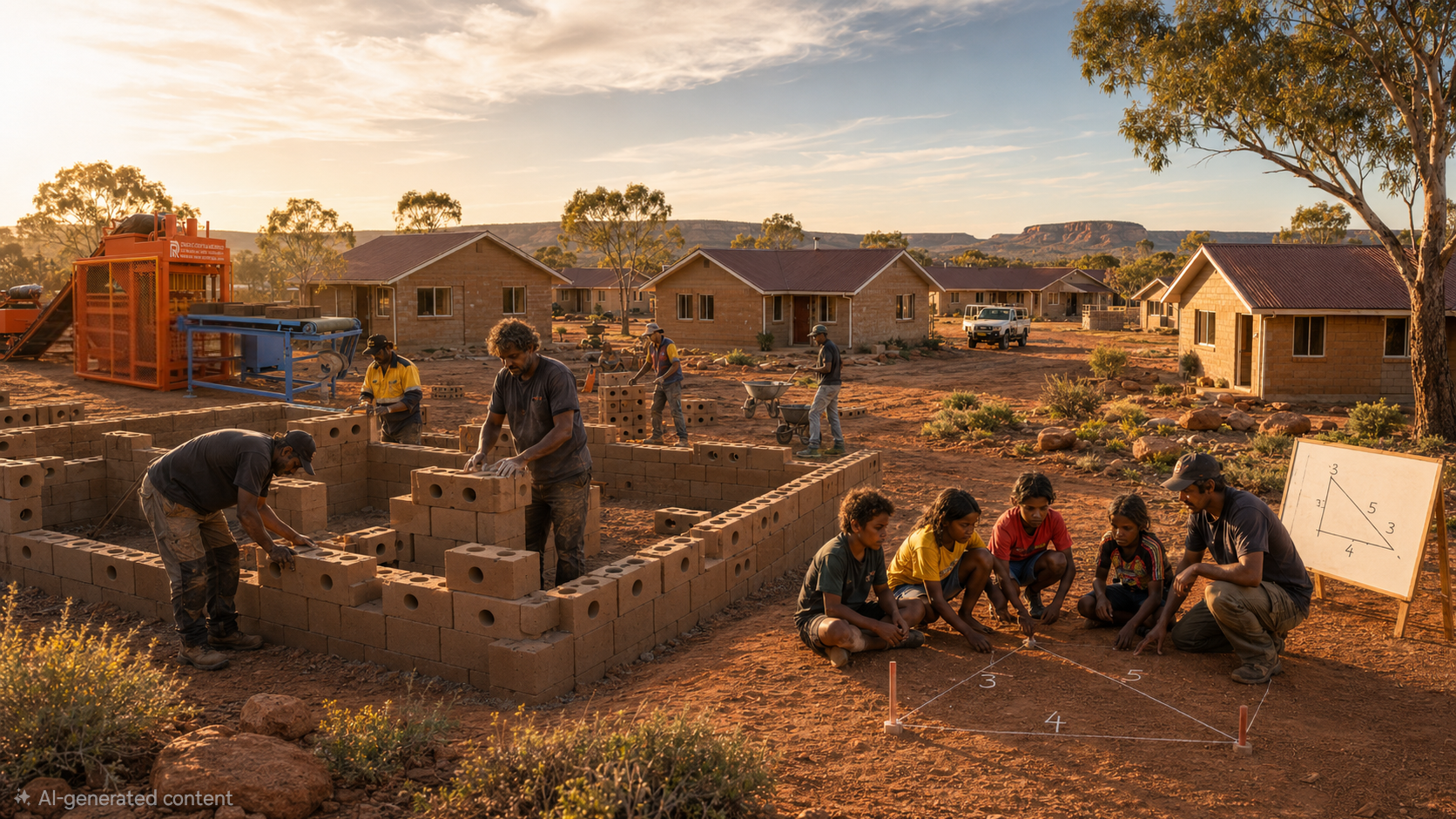
Homes and capability together
Local production, construction, learning and community infrastructure.
The organisation remains the client and decision-maker.
Kin-Neon is being developed as the delivery package underneath the legitimate funding and governance structure already available to the community.
COSTED TO WHAT IS AVAILABLE
A community may prioritise homes, an Elders facility, water infrastructure, local production capability—or a different combination. Kin-Neon's role is to turn those priorities into one coordinated and testable delivery plan.
A REPEATABLE PATHWAY
Start with the land, available capital and priorities determined by the organisation.
Work backwards from the available resources to a practical, costed community build plan.
Bring together the right mix of design, site works, plant, materials, training and infrastructure.
Develop local production and construction capability alongside the physical assets.
Build in stages, verify quality and carry the learning into the next community-led project.
ONE CONNECTED DELIVERY SYSTEM
The Kin-Neon framework brings the key components into a coordinated sequence. Each component remains subject to its own engineering, testing, approval and site requirements.
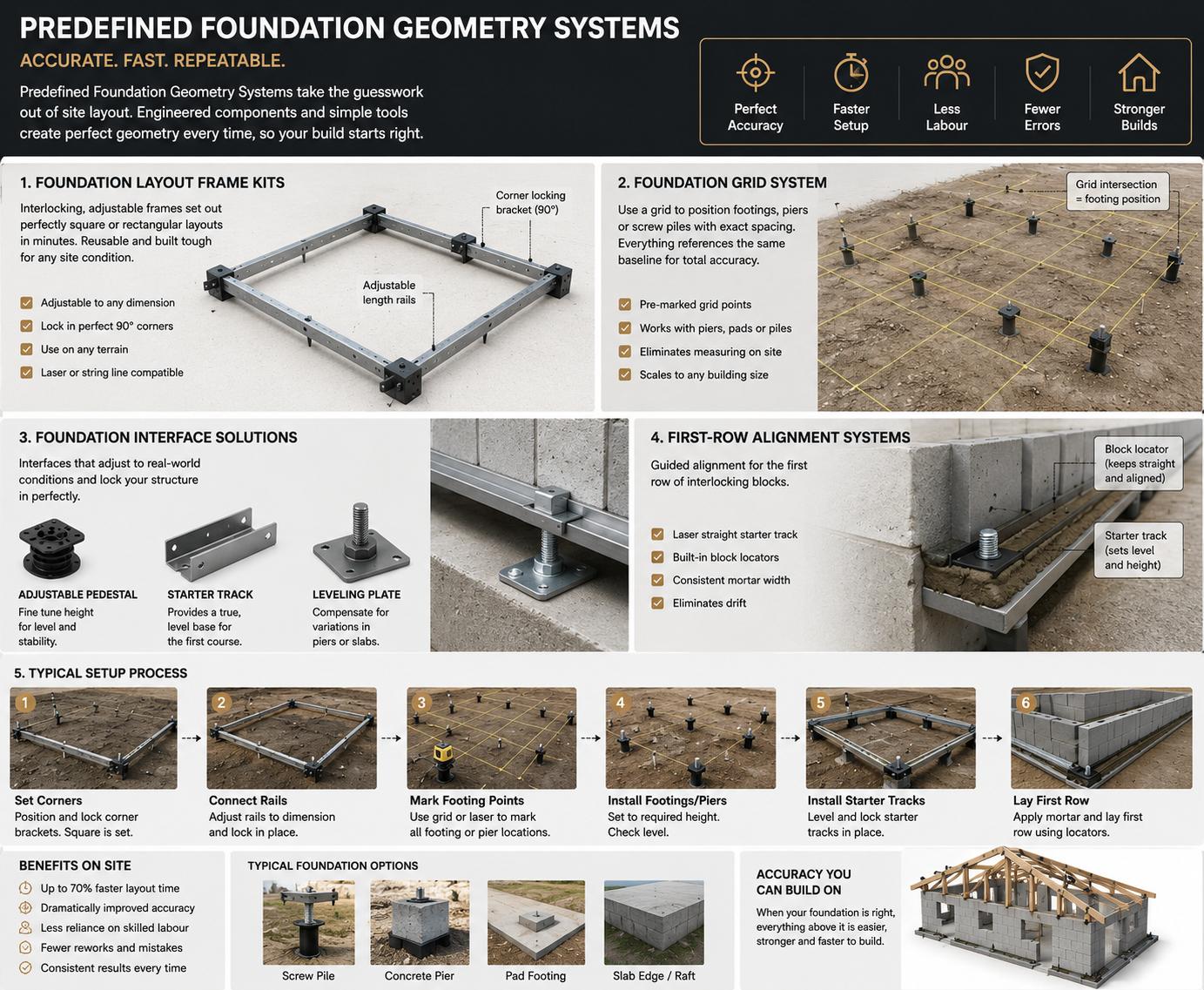
A proposed kit-of-parts approach to repeatable layout, footing positions and first-row alignment.
Download overview PDF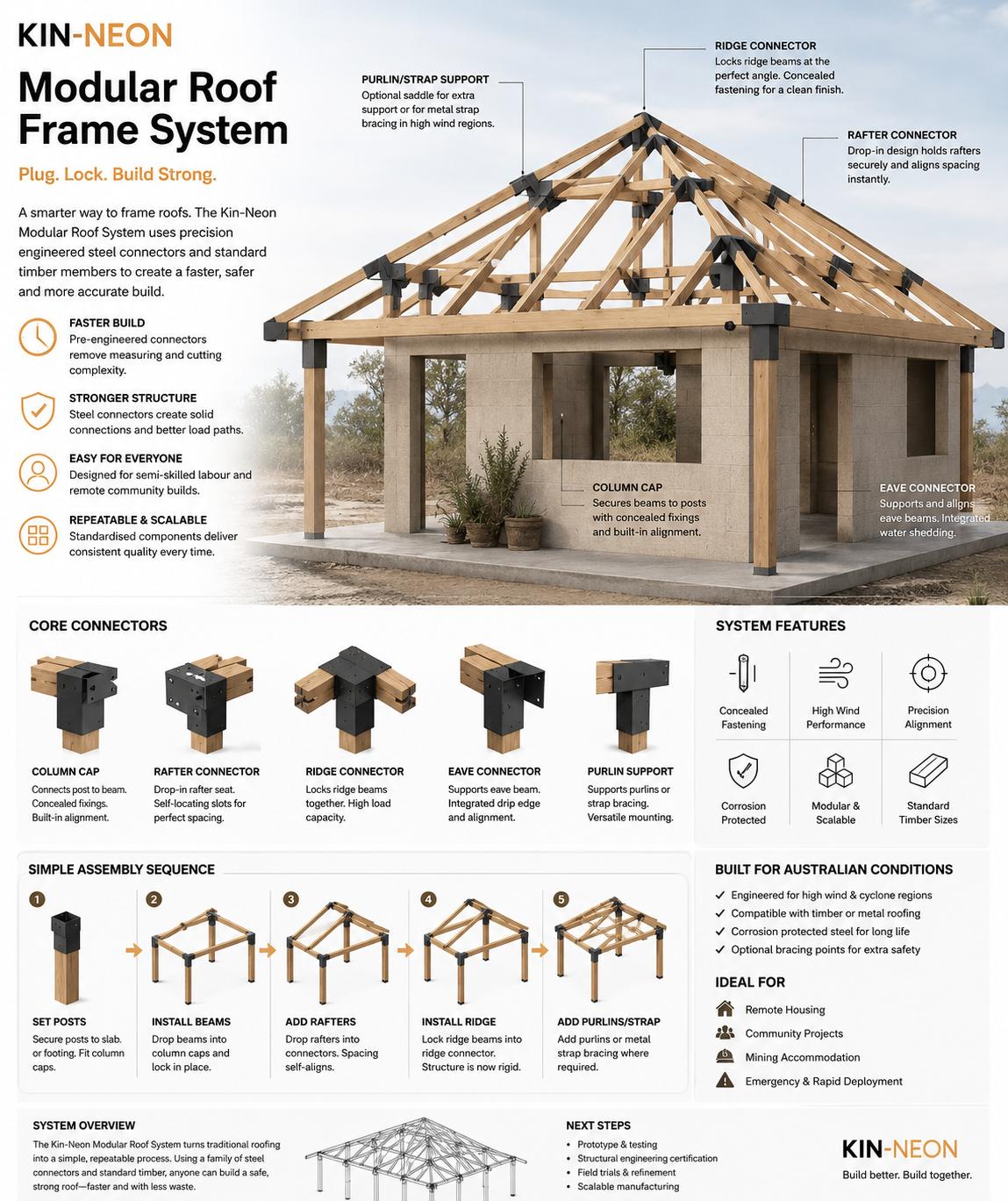
A modular timber-and-steel connector concept intended to simplify alignment and assembly.
Download overview PDFThe custom KN-1 prototype machine is intended to support controlled block production using locally assessed materials and an approved recipe.
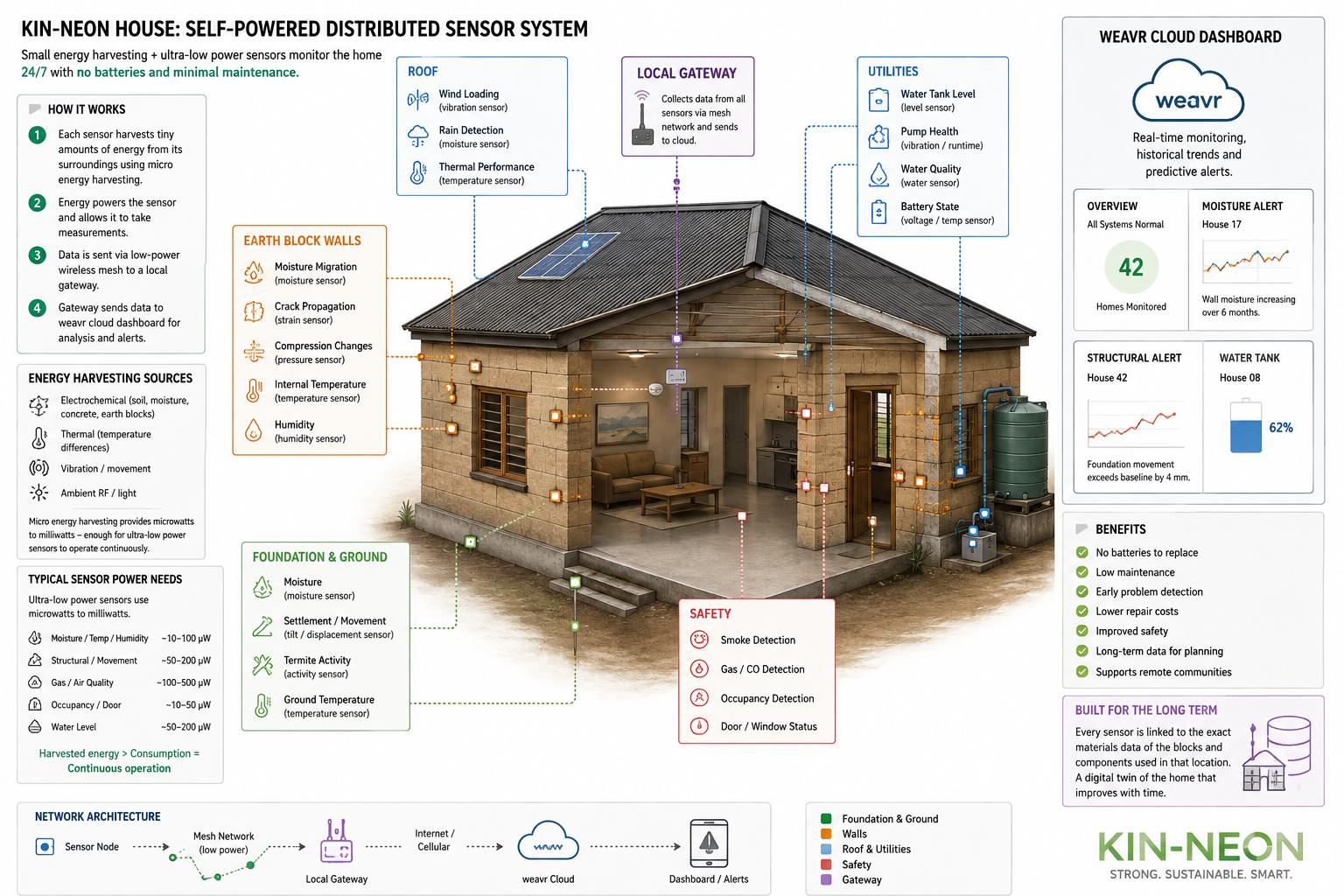
A development concept for low-maintenance monitoring of moisture, movement, utilities and safety. This is a future system direction, not a current deployed capability.
Download overview PDF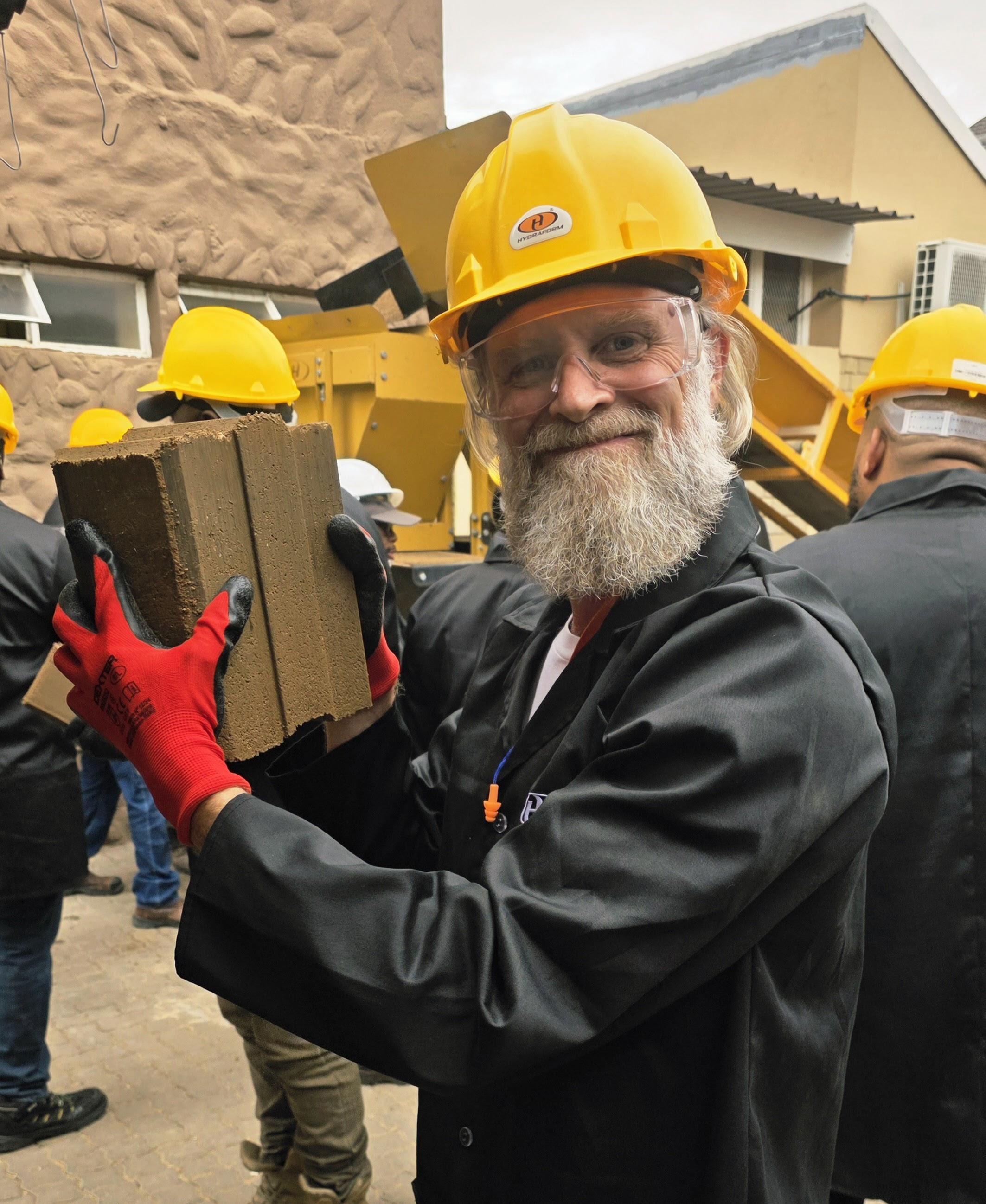
WHY THIS MATTERS
“This is single-handedly the most interesting real life application of STEM you will ever see.”
WHAT THE MODEL IS DESIGNED TO SUPPORT
Homes configured around local priorities rather than a predetermined catalogue.
Plant, training and repeatable systems that can remain useful beyond one build.
A pathway for local participation in production, construction and ongoing maintenance.
A delivery package shaped around the community's land, funding and decisions.
FROM ANCIENT PRINCIPLE TO AN AUSTRALIAN SYSTEM
Kin-Neon did not begin with a machine. It began with a question: how could a material principle that has served communities for generations be combined with modern engineering to make quality housing simpler, safer and more repeatable?
TANGIBLE PROGRESS
These project clips document manufacturer testing in May 2026 and the machine's subsequent arrival at the workshop. They evidence prototype progress—not certified block performance or commercial production readiness.
CURRENT STAGE
Kin-Neon remains a development initiative. The next phase is to bring the right organisations together to assess community need, delivery structure, engineering, materials, approvals, training, funding and commercial feasibility.
PROVEN PRINCIPLES. A NEW AUSTRALIAN SYSTEM.
Earth-based building is not an untested idea. Around the world, stabilised soil-block systems have delivered housing and public buildings while creating local production skills and livelihoods.
Kin-Neon does not claim that evidence as its own. It starts from those proven material principles and pushes the system further: controlled block production, precision geometry, modular connections, simpler assembly and future building intelligence.
A world-leading ambition, grounded in proof: make safe, high-quality housing easier and more affordable to produce under community control.
GLOBAL EVIDENCE
UN-Habitat reports more than 330 demonstration buildings and almost 3,000 people trained in stabilised soil-block production in Sudan.
Read the source
GLOBAL PRACTICE
UN-Habitat documents interlocking stabilised soil-block projects in Uganda, including their advantages, practical challenges and local lessons.
Read the source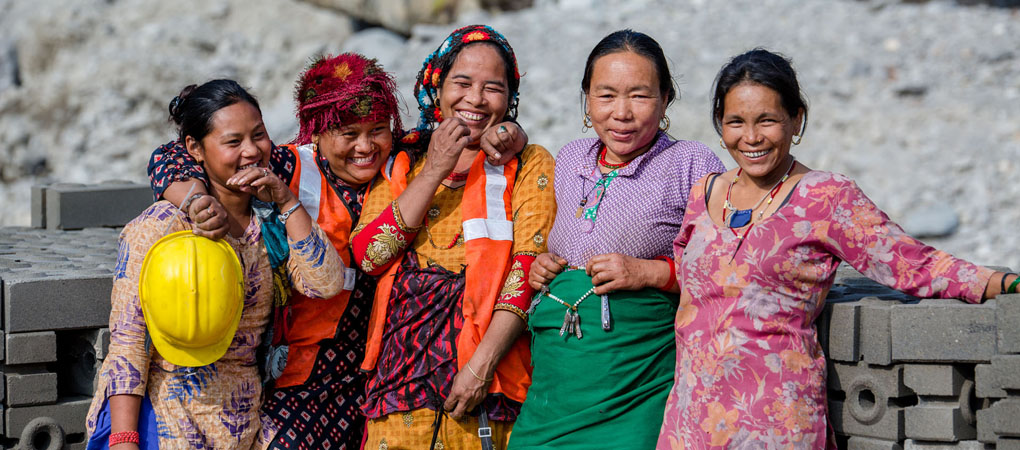
COMMUNITY ENTERPRISE
A World Habitat-recognised program in Nepal combines compressed earth bricks, safer housing, local materials and rural micro-enterprise.
Read the source
AUSTRALIAN NEED
AIHW reports that 68% of First Nations people in Remote areas and 45% in Very remote areas lived in appropriately sized housing in 2021.
Read the source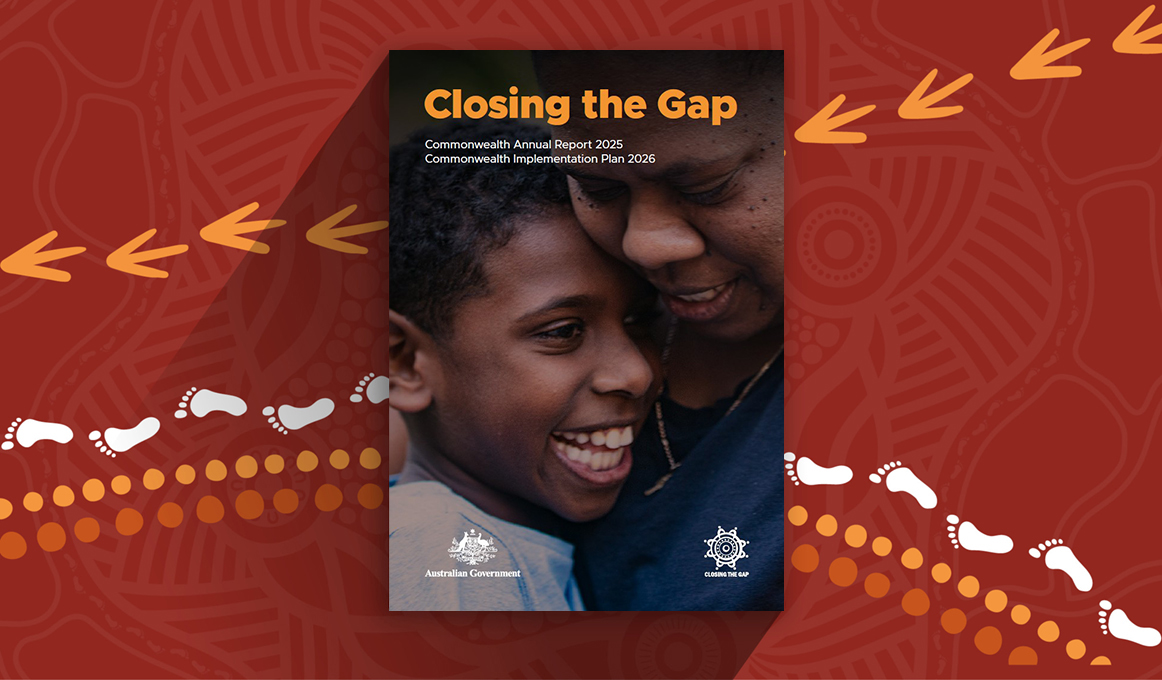
NATIONAL COMMITMENT
The 2025 Closing the Gap Annual Report records more than 300 new houses in remote NT communities and 1,450 remote jobs created.
Read the source
DELIVERY AT SCALE
The $4 billion remote housing agreement is being delivered with Aboriginal Housing NT, Land Councils and both governments across communities and town camps.
Read the sourceA curated evidence feed from primary and specialist sources. Links open on the publisher's website.
PRACTICAL QUESTIONS
Kin-Neon is a development initiative, so the responsible answer often depends on the community, location and agreed project scope. These are the principles guiding the work.
It can be, but that is not necessarily the best starting point. We prefer organisations to tell us what land, funding and priorities they have available.
We then work backwards with them to determine how that investment could create the greatest community value—including housing, local production capability, training, employment and infrastructure that remains useful after construction finishes.
Every project depends on its location, scale, approvals, services, materials and workforce. Once the local material recipe, batch processing and construction sequence are operating reliably, our target is a production rhythm capable of supporting up to one house per working day across the program.
Additional machines can increase production capacity, provided site works, crews, curing, transport, approvals and services scale with them. The entire delivery system—not one machine—determines the final output.
Kin-Neon is being designed to minimise reliance on scarce skilled labour without compromising safety or quality. Engineers, licensed trades and certifiers will still be required at specific stages.
With practical training, community members can participate in block production, assembly, logistics, measurement, quality control and maintenance. There are also valuable roles for Elders and others who prefer less physical work, including planning, coordination, checking, recording and knowledge sharing.
Every building must be engineered, approved and certified for its specific location. This includes structural performance, climate, wind or cyclone conditions, fire, moisture, termites, energy performance and essential services where applicable.
Local materials must also be tested and the block recipe validated before production begins. Kin-Neon does not replace the normal approval process—it is designed to make compliant construction more repeatable.
Compressed-earth and stabilised soil-block construction has been used successfully around the world for decades. Kin-Neon is developing an integrated Australian production and delivery system that combines those established principles with engineered foundations, modular roof connections, quality controls and local capability building.
We will clearly distinguish between proven construction methods and Kin-Neon components that are still undergoing testing, refinement or certification.
Yes. The model begins with the community's land, priorities, funding and decisions—not a predetermined catalogue of houses.
Standardised components make construction safer and more repeatable, but the project configuration can respond to local family needs, culture, climate, infrastructure and community objectives.
Potentially, but it must be tested first. Not every soil is suitable in its original form. The final recipe may combine local material with stabilisers, sand, aggregate or other inputs to achieve the required strength and durability.
Developing and controlling that local recipe is one of the most important early stages of each project.
The objective is to leave more than completed buildings. Depending on the agreed delivery model, that may include trained people, production equipment, tested material recipes, documented quality systems, maintenance capability and a pathway to future community-led construction.
Ownership, governance and ongoing operation of those assets would be agreed before the project begins.
Kin-Neon means “moth” in Gathang, the language of the Birrbay, Warrimay and Guringay peoples.
The name represents transformation. For many moths, the cocoon protects the pupal stage—the period in which one form is reorganised into another. Emerging with what they need to fly is an outcome; the important part is the process that makes that change possible.
Kin-Neon applies the same idea to community development. It is not about turning a community into something else. It is about bringing together land, funding, knowledge, technology and local capability so the potential already within the community can emerge—self-directed and free to fly.
FOR LAND COUNCILS AND FUNDING BODIES
Review how Kin-Neon is intended to turn housing capital into homes, employment, training, equipment and lasting community capability - under community direction and through a staged, testable delivery model.
Providing your details is voluntary. The brief is available without them.